

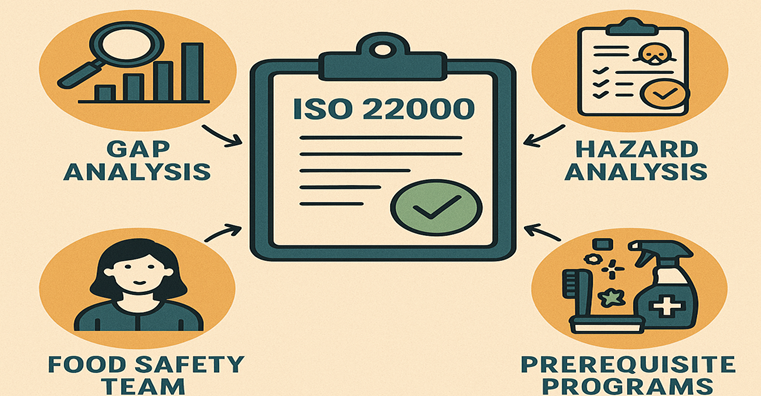
In today’s global food supply chain, both consumers and regulators increasingly demand high standards of food safety. To meet these expectations, ISO 22000—an internationally recognized Food Safety Management System (FSMS)—offers a robust and systematic framework. Specifically, it ensures that food products remain safe at every stage of the supply chain, from farm to fork. However, achieving effective food safety management through ISO 22000 is not just about obtaining certification. It’s about embedding a culture of safety, accountability, and continuous improvement across the organization.
This article outlines the essential steps organizations must follow to implement ISO 22000 successfully and reap its full strategic and operational benefits.
1. Understand the Standard and Its Strategic Relevance
It is important to comprehend what ISO 22000 is about and why it is important before jumping to implementation.
What is ISO 22000?
To begin with, involve top management as early as possible. Their involvement is crucial, as they play a key role in aligning business goals with food safety objectives. Furthermore, their commitment sets the tone for a culture of safety throughout the organization. Any organization in the food chain, whether big or small, can apply to it.
Why ISO 22000?
Moreover, it helps build customer trust, comply with international food standards, and significantly minimize the risks of food poisoning or product recalls—consequences that can lead to substantial legal liabilities and reputational damage.
Tip: To begin with, involve top management as early as possible. Their involvement is crucial, as they play a key role in aligning business goals with food safety objectives. Furthermore, their commitment sets the tone for a culture of safety throughout the organization.
2. Conduct a Gap Analysis
A gap analysis compares your organizations both. The gap analysis is done by contracting what your processes are to what is required by ISO 22000. The step assists in identifying:
- What already exists (e.g., Hygiene controls, traceability systems)
- What should be developed or enhanced (e.g., practices of formal risk assessments, documentation)
The advantages of Gap Analysis:
- Conserves time and resources as it aims at priority area
- The basis of your implementation plan is formed
3. Build a Skilled Food Safety Team
ISO 22000 emphasizes a competent food safety team led by a trained food safety team leader. This cross-functional food safety team is responsible for:
- Conducting hazard analysis
- Designing the FSMS
- Monitoring the effectiveness of controls
Key roles should include: Production managers, quality assurance personnel, maintenance staff, and even procurement—since all contribute to food safety outcomes.
Training is crucial. Ensure your team is trained in ISO 22000 principles, and internal auditing.
4. Identify Context, Interested Parties & Scope
ISO 22000:2018 requires organizations to understand their internal and external context and the needs of interested parties (e.g., regulators, customers, suppliers)
Steps:
- Conduct a PESTEL or SWOT analysis to identify external influences (e.g., food laws, market trends)
- Define the boundaries of your FSMS—sites, processes, and products covered
- Clarify legal and regulatory obligations
- This contextual understanding ensures that your FSMS is fit-for-purpose and aligned with your business reality.
5. Develop and Implement Prerequisites Programs (PRPs)
PRPs are basic conditions and activities necessary to maintain a hygienic environment. Examples include:
- Pest control
- Waste management
- Cleaning and sanitation
- Personal hygiene
- Supplier management
Use ISO/TS 22002-series (e.g., 22002-1 for food manufacturing) as guidance for industry-specific PRPs.
Tip: PRPs should be documented, implemented consistently, and periodically reviewed.
6. Conduct a Hazard Analysis and Establish CCPs
At the heart of ISO 22000 lies a systematic hazard analysis:
- Identify potential biological, chemical, and physical hazards
- Assess their likelihood and severity
- Determine Critical Control Points (CCPs)—steps where control is essential to prevent or reduce a food safety hazard to an acceptable level
The output is a well-documented HACCP Plan tailored to your operations.
Don’t confuse PRPs with CCPs: PRPs are preventive by nature and general; CCP are specific and must be monitored continuously.
7. Implement a Documented FSMS
ISO 22000 requires documented information to support the operation and control of the FSMS. This includes:
- Food safety policy
- Objectives and plans
- Procedures and records
- Emergency preparedness and response plans
- Monitoring and measurement systems
Well-maintained documentation ensures consistency, traceability, and audit readiness.
8. Communicate Internally and Externally
Effective food safety management requires robust communication—across departments and with external stakeholders
- Share food safety responsibilities clearly with all staff
- Ensure timely communication with suppliers and customers
- Maintain documentation of product specifications, changes, and incidents
- ISO 22000 promotes a culture of food safety, and communication is its backbone
9. Monitor, Measure, and Evaluate Performance
Once implemented, your FSMS must be monitored and measured regularly to ensure effectiveness:
- Use KPIs (Key Performance Indicators) like product recall rate, customer complaints, or CCP deviations
- Perform internal audits to identify nonconformities
- Conduct management reviews to evaluate performance and set improvement targets
This turns your FSMS into a living system—adaptive and responsive to new challenges.
10. Pursue Certification (Optional, but Powerful)
Although ISO 22000 certification is voluntary, it:
- Enhances credibility in the marketplace
- Facilitates access to new markets
- Fulfills contractual or regulatory requirements
First, choose a reputable certification body accredited by an internationally recognized accreditation body. Next, prepare thoroughly for both Stage 1 (document review) and Stage 2 (on-site audit) of the certification process. Additionally, ensure your team understands the audit expectations and is ready to demonstrate compliance in practice.
Epilogue: Beyond Compliance, Towards Responsibility
Food safety is not just about ticking boxes or passing audits. Instead, it is a moral obligation to protect consumers, uphold your brand integrity, and ensure long-term viability in a complex global food ecosystem.
While ISO 22000 provides the framework, true success lies in the mindset of your people, the systems you build, and the commitment you uphold every single day.
Moreover, in a world where one mistake can jeopardize lives and businesses, effective food safety management is not optional—it is essential. The journey to ISO 22000 excellence may be complex, but with the right guidance and strategic approach, it becomes a catalyst for trust, quality, and growth.
Explore our ISO 22000 training programs to start your food safety journey with expert guidance and hands-on support.