

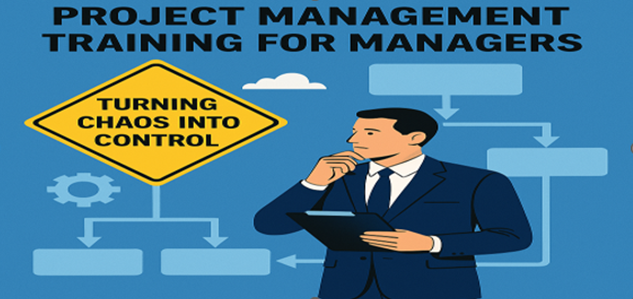
In today’s ultra-modern business world—marked by slim margins, fierce competition, and increasing regulation—the ability to execute diverse projects effectively is no longer a luxury; it is a core strategic strength. Nowhere is this more critical than in industries governed by strict standards such as ISO 9001, ISO 13485, or Good Distribution Practice for Medical Devices (GDPMD), where poor project execution can lead not only to budget overruns but also to legal non-compliance, reputational damage, and a loss of customer trust. Project management training equips professionals with the skills and discipline needed to deliver compliant, on-budget, and high-performing projects in such high-stakes environments.
Project management training is not optional when dealing with a manager who has to work in such an environment, be it in engineering, manufacturing, logistics, healthcare, or regulated medical devices environments. It is a savior. However, even to this day, most organizations treat project management as an ad-hoc firefighting (gut instinct) process rather than a planned, controlled, value-add process.
In this article, the author demonstrates that formal project management training can assist managers in making chaos productive. It decodes the fact that trained managers stand a better chance of delivering a project on time and on scope, controlling the risk effectively, communicating with the stakeholders, and aligning their projects to the objectives of the organization. It also emphasizes why this training is particularly important to invest in when it comes to regulated setting and how strategic expert-guided training can redefine not only the performance of one person, but also the level of maturity of a given organization.
The Problem with Untrained Project Management
The other misconception about project management is that it involves allocation of tasks and monitoring timelines. Actually, it is a multi-dimensional field which entails combining scope, time, cost, quality, human resources, communication, procurement and risk all in the absence of sound business strategy.
Without formal training, managers frequently fall into common traps:
- Overpromising and underdelivering due to poor scope management
- Budget blowouts resulting from inaccurate cost estimation
- Burnout and misalignment due to poor stakeholder and team communication
- Compliance violations because regulatory requirements were not baked into the plan
- Project derailment because risks were not anticipated or mitigated
This is increased in such cases of regulatory scrutiny in the industry. Take a distributor of medical equipment that goes to market with a product without being aware of ISO 13485 standards and, without intending to do so, violates compliance. In doing so, instead of frustrating schedules, restricted sales, recalls, and product recalls can result in, or even government penalties. In production, an ineffective change control within a Six Sigma project may lead to defective products, non-conformances or wastages.
The expense of out-of-control projects is such that it will cost an organization an enormous amount of money, in addition to trust, morale, and market position.
What Project Management Training Really Teaches
Project management training is not just a book knowledge. It develops useful and real skills that managers can apply instantly. A good training program gives managers the ability to:
1. Strategic Definition/Alignment of Scope
Managers are also taught to spell out project objectives, deliverables and criterion of success. They also are shown how to relate project objectives to organization strategy so that their work brings a measure of value.
2. Getting to Grips with Time and Resource Planning
With the help of such tools as Gantt charts, critical path methods, or agile sprints, properly trained managers can also plan the work effectively, assign realistic resource quantities, and add contingency plans. The result? It is easier to meet deadlines and becomes more productive.
3. Establish Strong Risk Models
A significant part of training is the risk management—a process of identifying any possible problematic situations, studying its consequences, and finding the methods of reducing its effect. This is particularly crucial in those industries where it has a regulated practice whereby non-observance is not an alternative.
4. Engage with the Stakeholders
Communicating in projects is not only about update, it is also a matter of managing the expectations, transparency and impacting the decision-making process. Learning imparts communication strategies, reporting schedules and identification of stakeholders.
5. Navigate Compliance and Quality Controls
In the case of the ISO certified companies, the approach is to train them in the right way to incorporate quality requirements, proper documentation, audit readiness and correct actions into the project plans hence compliance is not added as an afterthought.
6. Apply Common Tools and Techniques
Training provides global frameworks such as PMBOK, PRINCE 2, Agile or Lean, or a range of project management software such as MS Project, Asana, or Jira that are familiar all over the world. Managers acquire not only the skills of utilizing tools, but of when and why.
The Business Case for Training—Especially in Regulated Sectors
In the case of such industries as medical device distribution, manufacturing, pharmaceuticals, as well as engineering, the stakes are really high. Projects in these industries fail to accomplish their objectives not only when they miss deadlines or budgets but also when death or disease results from them or when regulators impose stiff penalties.
The Reason Why Training is Strategic within These Environments:
1. ISO 13485 & Medical Device Regulations
Strict regulatory frameworks govern every new product launch, recall, supplier change, or quality improvement project. As such, organizations must ensure compliance at every stage of these initiatives. Moreover, the complexity and risks associated with these activities demand a structured and methodical approach. In this regard, disciplined project managers play a critical role. With the right project management training, they have the ability to instill essential elements such as risk management (ISO 14971), document control, and traceability throughout all phases of the project lifecycle. Consequently, this not only helps in meeting regulatory expectations but also strengthens overall project performance, accountability, and long-term business sustainability.
2. Manufacturing and engineering projects
Whether it involves lean transformation or Six Sigma deliveries professionally educated manager understand how to ensure the balance between any efficient manufacturing and quality assurance, on the one hand, and production meeting the requirements of such industry benchmarks as ISO 9001 or ISO 45001, on the other hand.
3. Healthcare Logistics and GDPMD
Medical devices fall under GDPMD requirements. Therefore, proper temperature control and validated storage are essential. In addition, organizations must maintain a robust chain of traceability throughout the medical device distribution process to ensure compliance and product integrity. Training should specifically teach managers to plan and audit these processes in advance
4. Audit Preparedness and Constant Enhancement
Regulatory audits frequently focus on project planning, monitoring, and conclusion. Therefore, having a well-structured approach is essential. In this context, a well-trained manager will not only understand compliance expectations but will also be able to confidently submit properly organized documentation, thorough risk analyses, and comprehensive records of continuous improvement. As a result, the organization stands a much better chance of passing audits smoothly and maintaining regulatory confidence.
Turning Training into Transformation
Sending managers to a seminar is a different thing. It is one thing to plan the project management skills strategically throughout the firm. Most successful companies make training to be regarded as an event instead of a system.
Features of high-impact training program:
- Industry/ Role Customization
- The training provided must conform to the regulatory, operational and the cultural realities of the industry.
- To take an example, an engineering firm requires other case studies and tools in contrast with a drug distributor.
- Blended Learning
- A mixture of workshops, e-learnership, coaching and project work in the field promotes retention and behavior change.
- Applying knowledge to the job is the most vital bid to realizing knowledge into value.
- Mentorship and Coaching
- Post-training coaching reinforces what participants learn, supports implementation, and builds their confidence.
- Junior managers can be mentored by senior project leaders as an internal source of talent.
- Alignment with Certification Paths
- It is possible to match training with formal qualifications PMP, CAPM, or PRINCE2 certification which brings the credibility and recognition. Such frameworks are helpful even in cases where certification is not a target.
- KPI and ROI Tracking
- Organizations should measure the benefits of training based on project success, delivery schedules, cost reduction, and compliance levels. This makes training a strategic, rather than a costly enterprise.
Signs Your Managers Need Project Management Training
In some instances, training necessities are apparent. Other times it is slow burn. The following are indications of red flags that your managers need well-designed training:
- Sometimes projects run out of control in respect of budget or time.
- The stakeholders can be ill informed or not involved
- There is a mixing up of responsibilities or priorities on team members
- The concern of regulatory audits is on documentation or risk management
- There is no consistency, traceability or transparency of project reports
- The result is duplication of work or fire fighting at the last minute
- Experience in previous projects is failing to be captured and re-used
If any of them are true, project management training may quickly help you regulate the situation and establish a high-performance project culture.
Choosing the Right Training Partner
Training programs cannot be equal. Choosing a training provider or consultant, consider the following:
Industry Expertise – Do they understand your sector’s regulatory and operational challenges?
Customization – Can they tailor the content to your teams, projects, and compliance needs?
Methodology Agnostic – Do they blend traditional and agile approaches, or are they locked into one model?
Track Record – Have they helped similar companies improve project delivery or pass regulatory audits?
Support Beyond the Classroom – Do they offer post-training support, coaching, templates, or process reviews?
From Chaos to Control—Realizing the Benefits
When this project management training is successfully implemented, the change is real:
- Planning of the project ceases to be reactive
- Managers are able to foresee problems rather than respond to them
- The compliance requirements are not bolted-on
- Work groups work together and recognize objectives more quickly
- Delivery becomes confidence building to stakeholders
- The projects start to contribute in strategic direction terms not only the technical results
And possibly, most importantly, the organizations would acquire resilience internally, they would be able to deal with larger and more complex projects and would not have to rely on firefighting outside the organization.
Epilogue: The Strategic Edge of Structured Execution
In a world where innovation cycles accelerate, compliance tightens, and resources stretch thin, organizations must ask themselves:
Are we managing our projects, or are our projects managing us?
Project management training for managers is one of the most cost-effective ways to close that gap. It transforms chaos into control, stress into structure, and delays into delivery.
For regulated industries especially, it’s not just about productivity. It’s about protecting your license to operate. It’s about risk mitigation, strategic alignment, and building a culture of accountability and excellence. Whether you are a medical device distributor preparing for your next audit, a manufacturing company launching a new product line, or an engineering firm scaling operations—the time to professionalize project management is now.
And it starts with training your managers.
Ready to elevate your team’s project execution and compliance performance? Explore our tailored project management training programs at Insyst TAC.